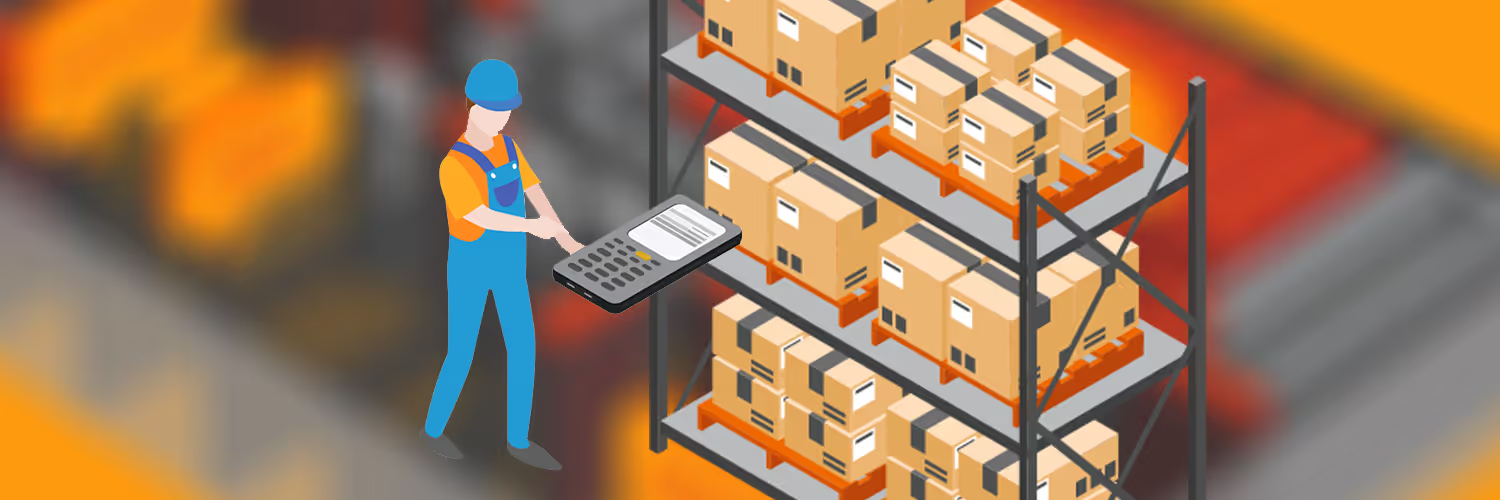
In warehouses where you ship dozens or hundreds of orders or orders with many items every day, it is financially and time-consuming for a warehouse worker to solve one order, then another order and so on. Warehouse workers unnecessarily wander back and forth through the warehouse, are inefficient and their work takes up too much time. Therefore, advanced warehouses are increasingly switching to multipicking - a system of picking multiple orders simultaneously by one warehouse worker.
What is multi-picking?
In a "classic" warehouse, an employee receives an order and picks individual lines item by item onto a pallet or into a box, which is then taken to the place where it is packed and shipped. In well-managed warehouses, this is helped by an information system that navigates the warehouse worker around the warehouse so that he picks the order as quickly as possible , walks or drives as few meters as possible, and also reduces the risk of mixing up goods to almost zero.
However, this method is difficult to sustain for large warehouses or even smaller warehouses that pick orders with many items. Although the warehouse worker picks each individual order without errors and in the fastest possible way, for example, when the next order is placed, he has to return to the place where he was a few minutes ago through the entire warehouse . In total, he is still relatively slow.
Therefore, multipicking – picking multiple orders at the same time – is increasingly being used in advanced warehouses. A warehouse worker drives or walks through the warehouse and picks items for, for example, ten orders at a time . For this type of management to function smoothly, it is necessary to implement a warehouse information system, such as LOKiA WMS .
Forms of multipicking
Multipicking in a warehouse can take many forms and variations. Companies with larger warehouses often use a system where one warehouse worker serves only part of the warehouse and simultaneously places goods from multiple orders in a designated location, where another warehouse worker picks them up and completes them with goods from other parts of the warehouse.
In smaller warehouses, a worker usually operates across the entire warehouse area. For example, if they are given ten orders to handle, the WMS automatically calculates the fastest route to pick all items from these orders, and then the warehouse worker takes them to a location where another worker sorts the goods according to the orders. In LOKiA, this system is referred to as simple multipicking .
Another option is multipicking with order consolidation , where the warehouse worker first prepares as many handling units (for example, pallets or boxes) as there are orders being picked. The goods collected from the shelves are then sorted directly into the prepared handling units according to the orders. This warehouse worker will be slower than in the case of simple multipicking, but the finished pallets or boxes can then be taken straight to the outlet and no one else has to sort them, so this method can be faster as a result.
Multipicking brings huge time and therefore financial savings to the warehouse. It is worth it for anyone who picks dozens of orders a day or orders with a high number (in the order of dozens and hundreds) of items. At the beginning, you need to carefully analyze the processes and set everything optimally, the subsequent implementation together with the implementation of WMS can be done in just a few weeks, at most months .
Ready to end the chaos in your company?
During a free consultation, we will review your current setup and recommend the next steps based on what your company actually needs.